
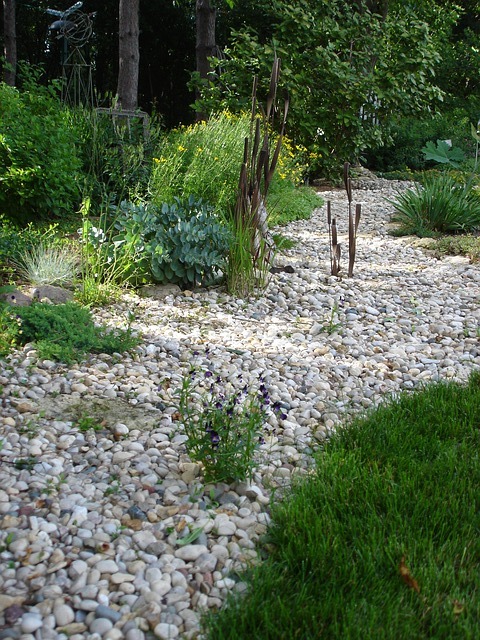
Rain garden designs are simple landscaping solutions to allow rain water to naturally soak into the ground. This helps deal with run off and storm water from roofs and pavements, and replenishes ground water whilst watering your plants and looking great.
“A rain garden is a shallow planted depression designed to hold water until it soaks into the soil“
GardenDesign.com
Introduction to Rain Gardens
Modern urban and suburban environments have high populations and ever increasing densities of housing, roads, buildings, car parks and pavements. This leads to a complex dilemma – how do we find a sustainable solution for all the rain and storm water run off?
Currently, storm water is diverted from where it naturally falls; through gutters, pipes, drains and trenches rain eventually finds itself being dumped into ponds, rivers, lakes or oceans; bypassing the natural ground soak mechanism of our water cycle. This can lead to drier soils, lack of water supply to plants and soil microbiome, and starves natural ground water reservoirs of replenishment – potentially even lowering the water table and causing natural springs to cease flowing.
This can be overcome somewhat using correct civil and storm water planning, but a very simple landscaping technique we can all adopt is to build rain gardens to allow our rainwater to naturally soak into the Earth.

What is a Rain Garden?
Rains Gardens are natural garden depressions which are nourished by, and deal with an excess of rain water. These gardens are designed for landscapes specifically to reduce the flow rate, total amount, and a load of pollutants from urban areas.
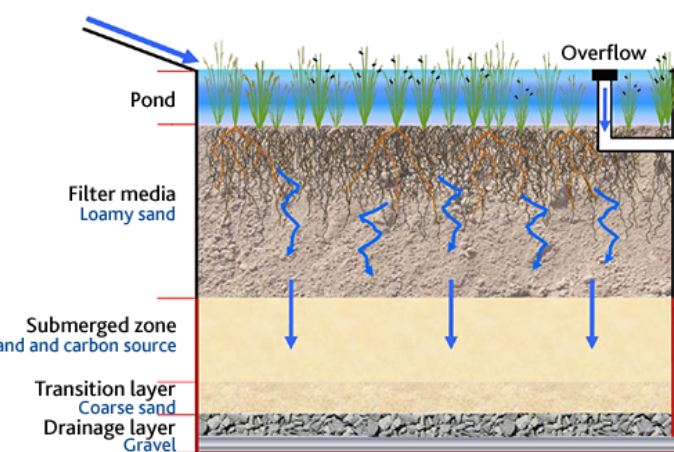
They typically consist of depressions or trenches which might be filled with a layer of with gravel or rocks, and then are shallowly covered in soil and planted over. As the purpose of the rain garden is to filter any rain, storm-water or urban runoff , the soil concentration should be adjusted between sand, clay, gravel and organic matter to promote soakage.
These gardens typically contain grasses, rushes, ferns, small trees and shrubs. These plants benefit from essential nutrients (such as calcium) that soak into the soil from the draining water from roofs and other areas, and work together with soil microbiome to break down and filter any pollutants. This is great example of the application of permaculture.
The root system of these plants can be quite deep and create a ‘root channel’ to filter rainwater and as it passes through on its way into the water table. In this way, they are useful in filtering storm water before it enters the water table or nearby water bodies – so they are also known as bio-filters.
These plants also prevent erosion and muddy water pollution as their roots help hold the soil together. As the plants soak up this water, they can store it within their deep roots and some of it is returned to the environment through transpiration.
“Transpiration is the process of water movement through a plant and its evaporation from aerial parts, such as leaves, stems and flowers. This is due to air that is not at 100% humidity drying out the cells of the plant during photosynthesis. Approximately 97–99.5% of a plants water is lost by transpiration “
John W. Kimbal, Introductory and General Biology.
Rain gardens are also helpful in reducing energy consumption by reducing the load on conventional storm-water infrastructure. As the rain garden may hold water for some time as it slowly soaks into the ground, through evaporation some of this rain water is evaporated back to the atmosphere.
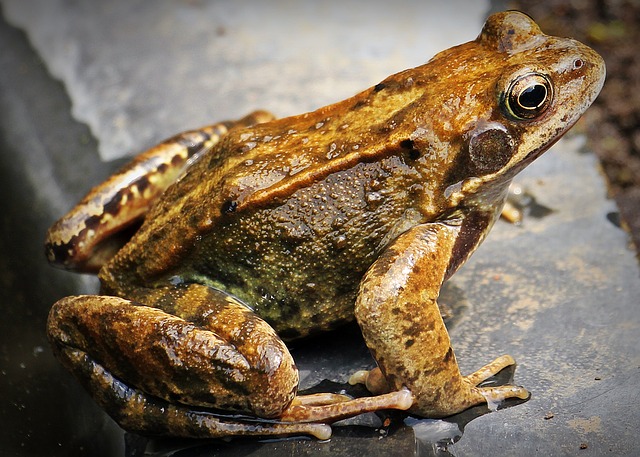
Rain gardens also encourage wildlife and form habitats for native butterflies, birds, and insects.
Building a Rain Garden
First of all you need to think about your rain garden design – it depends upon your efforts and how ambitious you are, but some questions you might want to consider are;
- Where will it go
- How big will it be
- How much water will it need to deal with
- What plants will I use?
Once you have decided on some basic features, you need to dig out a long ditch or depression to form the base of rain garden – you can shape or curve this however you like, perhaps forming a lovely meandering watercourse through your garden – but be careful about any underground utilities.
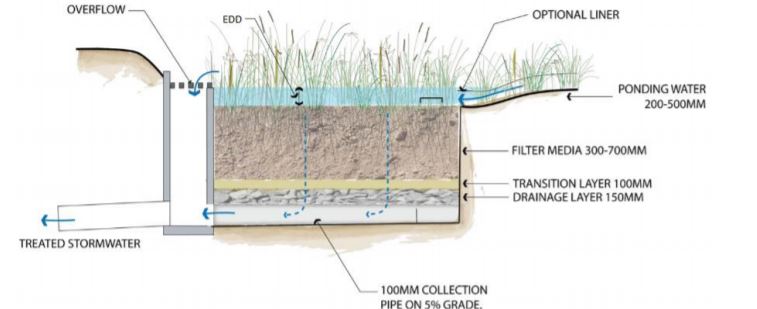
Next you lay your gravel on the bottom which forms the base of the drainage pit and allows water to soak into the rain garden quicker. A few inches will be plenty
Next cover your gravel with a layer of loamy sand of an inch or two (this helps prevent soil being washed down into the gravel and helps with filtering and drainage)
Cover your sand with a layer of well draining mixed soil (compost, sand and dirt) of at least 300mm (one foot deep) but ideally around 500mm (almost two feet) which will form your planting medium, and then mulch it appropriately (for example with bark chips)
You can place stones and pebbles along the water way, as well as build up any down-slope on your property to prevent from an overflow of soil. Ideally, the rain garden should be able to hold 20 to 50cm depth of water, so you can build up the edge heights according to your design.
Now you can plant all all of your chosen plants in your rain garden – natives will do especially well in rain gardens.
Moreover, water can be carried out to your rain garden through an extension at the end of your downspout or rain water tank overflow, or you could extend your rain garden up to it using a water course bedded with decorative rocks, pebbles or slate and can be lined with plants – your only limit is your creativity!
Larger rain gardens can be designed with drainage into conventional soakage pits or into storm water intakes, which is typically employed by councils when looking to improve the quality of urban storm water run off
Which area is best suited for a rain garden?
Rain gardens are frequently used in low areas or depressions, near sources of water such as rainwwater tank overflows or downspouts, and at the base of inclines.
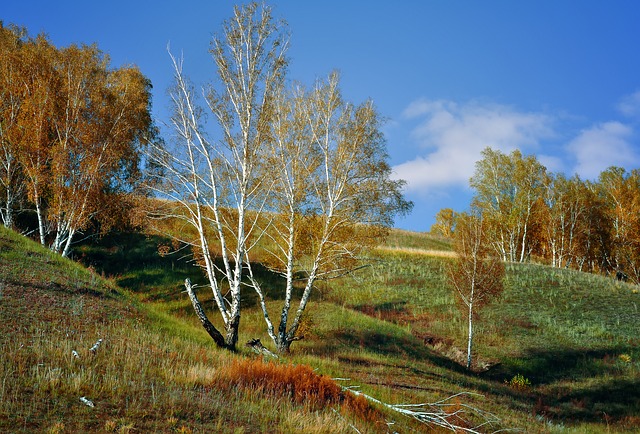
Sloping blocks and inclines can be great for rain gardens; using furrowing, swales, berms, micro valleys and ridges to create rain gardens which catch and hold water allowing it to soak into the ground rather than becoming nuisance run off and potentially damaging gardens down slope.
Existing gardens can be easily adapted to become rain gardens with a bit of digging and the addition of gravel, however if these gardens have overly sandy or clay soils they may need to be augmented.
Once the soil reaches its saturated state it pools off excess water on the surface and infiltrates the natural soil below. Soil should contain about 60% of sand, 20% of compost, and 20% of topsoil. Non-permeable soils like dense clay should be removed or enriched with organic matter and sand periodically to enhance bio-retention and the drainage system.
However, some experience shows that rain gardens in urban clay soil could be used for retention without any soil augmentation. Trial and error is the best way to find out what works for your property.
Locations which are not Suitable for a Rain Garden
Very steep slopes however may not be appropriate for large rain garden depressions without structural reinforcement, because it could cause land sliding; when a lot of water is absorbed by the soil it becomes heavy and soft, losing its structural integrity meaning it can be ‘washed down’ the slope
If you want to place a rain garden in your home’s backyard it should usually be at least 3 meters away from your home as it could harm your garage, house or neighbors property. The increased soil moisture concentration from the rain garden soak could can damage to your foundation, salt damp, or even basement flooding.
Before digging, you should also consult, locate and mark out all the utilities by using underground infrastructure map. Some locations will just not be suitable for rain gardens due to the proximity to storm water pipes, easements, electrical conduit, gas pipes or other structures.
If your area has rain run off with a high sediment load such as nearby tilled vegetable gardens, disturbed areas or construction sites upstream this can cause clogging of your rain garden and will interfere with the proper drainage of the soil underneath.
Areas of high water flow such as creeks and catchments might not also be suitable for rain gardens, because the heavy flows can cause scouring of the rain garden (erosion), carry away plants as well as build up large sediment deposits.
Finally, if the prospective location of your rain garden generally has pretty poor drainage, then building a rain garden might not be the best idea there as you could simply be adding to the problem – and long standing water could lead to algal growth.
Tips for a best Rain Garden Design
Designing your Rain Garden depends upon your own creativity – it could be shaped and molded as you like! You can design your rain garden according to your passion. You can either use a modern landscape or a countryside look depending on your choice of river stone, pebbles, slate or even concrete or concrete blocks. You can choose a variety of flowers, shrubs and grasses to create a depth of blossoms, colors, heights and textures.
A rain garden should generally have a wide range of features and plants for bio-retention and drainage; many plants do not have the strength in their roots to hold saturated soil – so, the choice of plants in your rain garden should be in accordance with the location; steeper blocks will favour larger shrubs and trees, and flatter blocks can get by with shallow grasses and flowers.
Ideally, plants should have;
- A high root density
- Extensive fibrous root systems (and not have any bulbs)
- Have vigorous growth
- Be tolerant of freely draining sandy soils
- Be drought and inundation tolerant
- Be hardy and deal with temperature variations
Great examples for rain garden plants include;
- Carex appressa (tall sedge)
- Ficinia nodosa
- Lomandra longifolia
- Juncus amibilis
- Goodenia ovate
- Juncus flavidis

Your rain garden design could be considered as an extension of homes existing landscape, and also the landscape for the neighborhood. If you are designing a rain garden visible in your front yard or to the community, you might have to conform to neighborhood appearances or community standards.
Cleaning your rain garden
After heavy rains, you will likely need to clear your rain garden of debris that collects on the surface after it is washed in by the rain. This can be raked away or collected and composed, and any rubbish recycled or disposed of appropriately.
Do not spray or fertilise your rain garden
Remember not to fertilise or spray your rain garden with pesicides. The rain water itself will wash enough nutrients into the gain garden for the plants, and the water will wash away any fertiliser and any pesticides away which will just become pollution and find their way into ground water or water courses. This can have serious consequences down stream like fish kills and algal blooms.

Native Plants for Rain Garden Design
A rain garden should have the plants which cope well with both wet and dry conditions, as well as sandy soils, because rain gardens need to tolerate both alternative flooding and tough summer days. Native flowers, shrubs, grasses and ferns can usually meet this criteria and they are the best friend of your rain garden. Native plants also support local wildlife, and are sure to attract a variety of beneficial birds and insects into your garden.
Grasses and reeds Rain Garden Design
You can use different grasses and reeds according to light and heat conditions for your rain garden. Grasses are fairly shallow rooted and help hold the soil (and mud) together, so grasses are best planted as complementary ground cover to go around some larger plants such as reeds and bamboo (just make sure you get the clumping and not running variety of bamboo).
Flowering Plants and bulbs for Rain Garden
Some flowering plants can also help you to style your rain garden and bring in lovely color and texture to enhances its aesthetics. Some flowering herbaceous plants include freesias and daisies, however bulbs are not recommended as they can rot when submerged in rain gardens for long periods of wet weather.
Shrubs and trees for Rain Garden
To enhance the beauty and efficiency of your rain garden, you can add some larger shrubs and trees to your rain garden.
Conclusion
Rain gardens form one of many ways to manage rain and storm water run off in your garden.
They are a very simple and easy to make drainage solution, and help rain water to soak deeply into your garden. This reduces surface pooling, nourishes your plants and helps to recharge ground water supplies.
Check out some of these best rain garden plants to get some inspiration about designing and building your very own rain garden!
Have you ever designed or built a rain garden? Share your experience and tips with us in the comments below!