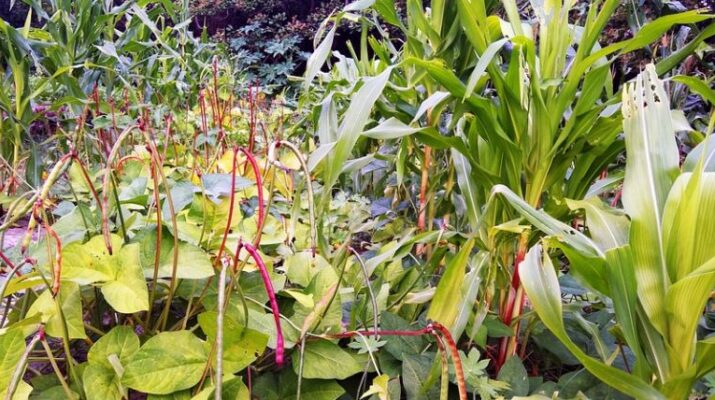
This article covers the design, implementation, and management of food forests and syntropic agroforestry as a food production system.
What is a food forest? Food forests are edible forests, a permaculture design system technically referred to as syntropic agroforestry food production systems.

Introduction to food forests
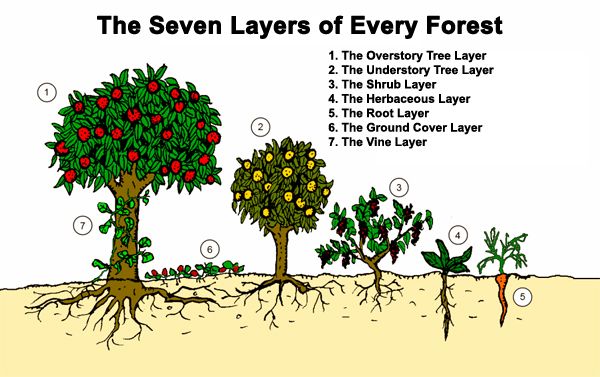
Food forests are a sustainable organic system that is designed in seven layers and feature a canopy, understory, bush, herb crops ground covers, vine and root crops layer
The tall trees protect the small trees, providing shelter from harsh sun and wind and allowing fruiting shrubs and ground cover plants to work together build a local ecosystem for food supply.
All of the plants in a food forest work together to help to prevent pests and diseases, cycle nutrients and on soil building, and they are supported by rich and diverse soil biota such as fungi and microorganisms. Food forests can be found all over the world from many tropical regions to arid to temperate climates, and they provide locals with fresh fruits, vegetables, nuts, seeds and medicines.
In comparison to traditional agricultural systems for edible crops, food forests are more efficient as they mimic natural ecosystems and require less human intervention to obtain a maximum yield. There is virtually no limit to the number of edible plants that can be used in forest gardening for food production.
Why grow a food forest?
Food forests are an ideal way to cultivate and harvest your own food. They can be created in your backyard or on a larger scale, such as on farms. A food forest provides you with fresh fruit, vegetables and medicinal herbs for free. It is also great for the environment because it is organic and uses natural methods to encourage growth and prevent pests.
What are the benefits of a food forest?
Food forests have many benefits, such as:
- Providing food security in a time of drought and rising food costs.
- It is an ecofriendly way to provide people with healthy organic produce without harming or depleting natural resources.
- A food forest incorporates biodiversity that can be enjoyed by both humans and wildlife
- A food forest creates a microclimate within its borders due to the diversity of plants it contains; this means no pesticides will ever need to be used on your crops again as you harbor a diverse food chain of predators to control pests
- Food forests also improve soil health with their roots which prevents erosion from happening too often – food forests are a great way to prevent or reverse desertification.
What can you grow in a food forest?
A food forest is a mix of plants that grow symbiotically to be best suited in your growing location. In Australia, a food forest typically contains a mix of canopy trees, understory trees, bushes, shrubs, ground covers, vegetables, herbs and root crops including;

Pioneer and Legiminous trees for food forests
Pioneer trees are the first generation of hardy and vigorous trees that you plant in your food forest that grow out as canopy trees as you transform the area into a suitable microclimate for more delicate crop plants. They are often the tallest trees and the canopy trees grow first to protect the understory plants
Nitrogen-fixing (leguminous) trees fix atmospheric nitrogen into the soil using their specialised root systems and symbiotic relationship with soil micro organisms and fungi. Leguminous trees include;
- Acacia, black wattle (Acacia mearnsii)
- Jumbay, river tamarind, white leadtree, Subabul, white popinac (Leucaena leucocephala)
- Casuarina, ironwood, beefwood, Australian Pine, she oak (Casuarina equisetifolia)
- Desert Ironwood, Arizona Ironwood, Palo-de-Hierro, Palo-de-Fierro (Olneya tesota)
- Velvet Mesquite, Common Mesquite, Arizona Mesquite etc (Prosopis velutina)
- Oak
- Pine trees
Fruit trees for food forests;
Fruit trees are one of the main crops in the food forest, providing the vector for output of the forest via manual food harvesting. By planting a huge excess, you will ensure there is enough for both yourself and local wildlife. To ensure blemish free fruit, you can use strategic netting, covering or even planting some inside an exclusion zone.
- Mango
- Avocado –
- Banana
- Peach (White, Yellow, Gold)
- Nectarine (White, Yellow, Gold)
- Peacherine
- Apricot
- Plum (Black, Red, Satsuma)
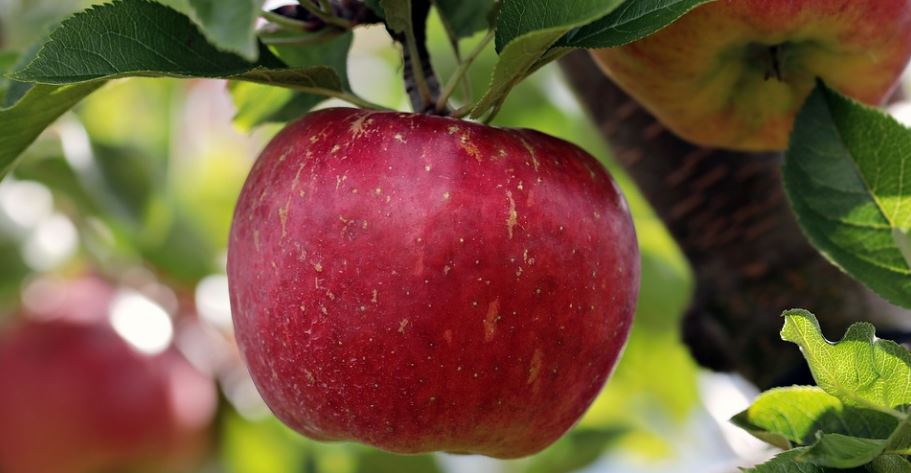
- Apple (Green, Red, Jonathon, Gold, Ballerina, Granny smith, Sundowner, Opalescent, Pearmain, Rokewood, Summer strawberry, Prince Edward, Royal Gala etc – there are thousands!)
- Pears (Beurre Bosc, Giant Korean Nashi)
- Cherries (Lappins, Merchant, Morello, Bing, Lapin, Van, Sweetheart, Ron, Skeena, Regina, Staccato, Sequoia, Dawn series, Simone and Kordia to name a few)
- Figs (hundreds of varieties) Figs are very hardy and make a great choice
- Prickly pear cactus (watch this one doesn’t spread)
- Pomegranate
- Lemon (Eureka, Lisbon, Meyer)
- Lime (tahitian, Makrut – Kaffir)
- Orange (Washington, Navel, Blood)
- Grapefruit (Ruby Red, Blood, Pink, White)
- Mandarine (Emporer, Japanese, Gaypac)
- Cumquat
- Pomelo
- Tangelo
- Jujube (Chinese dates)
- Sapote (white and black)
- Mulberry (Black, White, Pakastani, Shatoot, King)
- Feijoa (Pineapple guava)
- Guava (Pink, Hawaiin, Strawberry)
- Loquat
- Persimmon
- Australian native finger lime (red and green)
- Lychee
- Papaya
- PawPaw
- Quince
- Lillypilly
As you can see, the possibilities are endless! The trick is finding the kinds of fruit you like,and that will thrive in your conditions. If the conditions arent right, continue with your pioneer species and chop and drop mulching and soil conditioning to improve the soil microbiota and micro climate.
You can take a look at an article I contributed to about ‘The Best Food Producing Trees Favored by Preppers & Homesteaders’ HERE.
Nut trees for food forests
Nut trees provide some of the most valuable harvests and are highly sought after. Just be sure to plant enough to feed yourself AND the local wildlife, as you may find them getting raided at certain times of the year. Strategic netting can help,as well as planting within netted areas of the food forest.
- Almond
- Walnut
- Macadamia
- Pistachio
- Pecans
- Hazelnuts
Fruit bushes, berries, vines and perennial vegetables for food forests
Fruit bushes, berries and vines are great for making up the intermediate levels in your food forest, gathering either full of dappled light through the main and upper canopies from your pioneer, shade and fruit and nut trees
- Raspberry
- Blackberry
- Goji Berries
- Grapes
- Kiwi fruit
- Passionfruit (Gold, Black, Banana)
- Gooseberry
- Currants (black, white and red)
- Jostaberry
- Cranberries
- Dragon Fruit
- Pepino
Herbs for food forests
Herbs are great in food forests and range from trees, bushes and shrubs to herbacious ground covers. Herbs make fantastic pollinators and companion plants and help promote a thriving and diverse ecosystem.
- Thyme
- Rosemary
- Sage
- Mint (chocolate, peppermint, spearmint) – can be invasive
- Lemon grass
- Parsely (Flat, Curly, Italian)
- Basil (Purple, Thai, Sweet, Lemon, Italian)
- Sage tree
- Curry leaf tree
- Sugar Cane
Ground covers and flowers for food forests
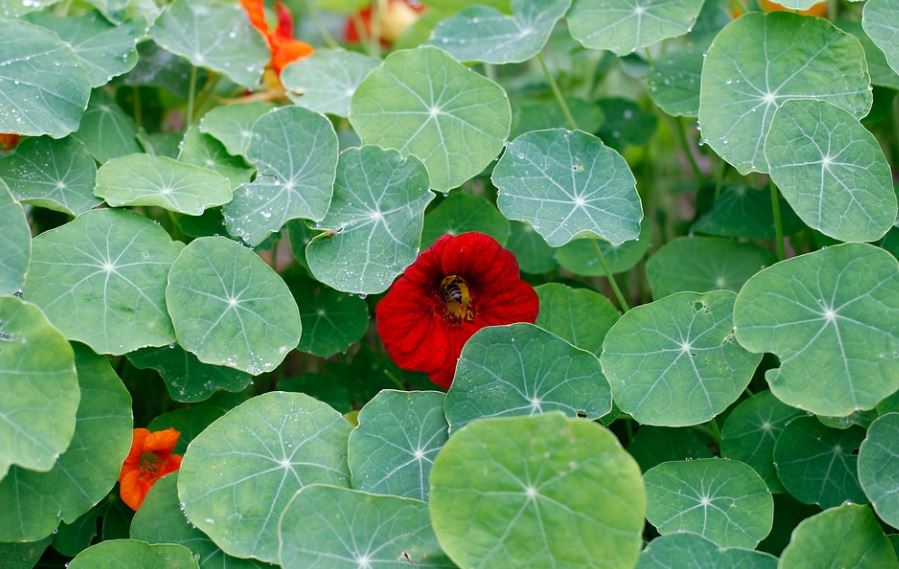
A few example ground covers you can use to keep the soil protected and form the ground layer of your food forest include;
- Strawberries (although they only last a few years each due to fungal issues)
- Memory plant
- Native spreading daisies
- Pigface
- Creeping boobialla
- Sweet potato
- Wild Garlic
- Geranium
- Sweet violet
- Clover
- Comfrey
- Melons (watermelon, Rockmelon, Honeydew)
- Wandering / climbing Peas, Beans and Curcubits (cucumber, pumpkin etc)
- Lavender
- Ficus
- Jasmine
- Marigold
- Alisium
- Borage
- Petunias
Annual Fruit and Vegetables that can be grown in food forests
You can grow annual fruits and vegetables in food forests such as
- Tomatoes
- Potatoes
- Onion
- Garlic
- Peas and Beans (fantastic leguminous choice for aiding the soil)
- Cucurbits such as Cucumbers and Zuccini and pumpkins
- Leafy greens like Lettuce, Spinach and Beetroot
Animals for your Food forest
Animals actually make a crucial part of the ecosystem in a food forest. In addition to attracting native wildlife such as birds and insects, many people choose to introduce domesticated species to farm for a yield, which has the massive added benefit to turbocharge the soil health with their droppings and nutrient recycling via feeding them household scraps and plants grown in the food forest.

Common animals in food forests include;
- Chickens
- Ducks
- Quail
- Geese
- Goats
- Sheep
- Pigs
- Cows
Other flora and fauna for your food forest
You can also include Fungi and seed your own edible mushroom spores throughout your food forest design to help turbocharge the soil health and the speed at which wood is recycled on the forest floor.

For example, planting hazelnuts or silver oak can provide a suitable host for truffles if growing conditions (temperature, rainfall etc) are suitable, and mushrooms grow often in leaf litter or on decaying wood.
Introducing worms via having several worm farms within the food forest and spreading their egg-containing castings is a brilliant way to encourage healthy soil life throughout the food forest.
Furthermore, it is a great practice to help seed bacteria in the soil and you can do so by adding fermented homemade soil conditioners and compost in the root zone of your trees.
You can grow just about any other plants you like, such as medicinal plants.
How do I get started with my own food forest?
The first step is to assess your needs and the space you have available for growing.
You should draw up a scale diagram, and enlist the help of a permaculture specialist or surveyor to document what you are working with.
Once you have determined what you have, your rainfall level, your ability to landscape and would like to grow, you can begin to map out your food forest.
Mapping out your food forest using permaculture design principles
You will need to decide on the layout of your forest and what plants will go where. Be sure to take into account the sunlight requirements and water needs of each zone, and how they will interact with the landscape i.e. swale positions, fences and animal rotations.
Designing your forest farming layers
Food forest gardens are typically designed in seven layers with all of the plants working together as a giant permaculture garden or edible landscape;
- Canopy: The pioneer tall trees species grow to provide the canopy or overstory tree layer to provide shelter from the sun’s rays. These can reach great heights of over 5m
- Understory: Understory trees are smaller trees which fit under the canopy and typically under 5m tall
- Vines and creepers: Vines and creepers occupy vertical space, and vines grow in places such as on the trunk of the tall trees that provide the canopy.
- Small trees, Shrubs layer: Small trees, Shrubs and bushes which are typically under 2m tall make up the shrub layer
- Herbaceous layer: Herbs such as Basil and lemongrass which are typically under 1m
- Ground cover layer: The ground cover protects the soil, and grows in partial shade
- Root crop: The root crop layer is under the soil, such as where sweet potatoes and yam tubers grow.
Succession plan
Once you have planned out your food forest, you need to come up with a succession plan for how you will slowly convert the current land into a food forest. As an example, this might include planting very hardy pioneer species such as Acacia (black wattle) to provide shelter for younger, more delicate saplings such as fruit trees.
When plants die, or you need space, the initial pioneer species can then be cut down mulched, fed to animals or simply ‘chopped and dropped’ to provide nutrients to the soil. This will allow more sunlight once your young trees and fruit tree saplings have started to mature and don’t need as much protection.
Because the tall trees have deep roots, they will help stabilise and feed the soil long after they are mulched.
“A forest grows on a fallen forest”
Geoff Lawton
Landscaping your food forest
Once you’ve mapped out your food forest and succession plan, it is time to landscape.
You can use tools and machinery such as diggers to break up tough soil, and make mounds to provide shelter from winds, build raised beds, and direct water flows by building swales to capture and maximize use of rain.
Swales allow rain to soak into the land where plants can use it, rather than flow over the top of it and away from the property. Swales are simply mounds that run parallel to contours, helping slow water flow down slopes and directing it into the soil.
Consider the strategic use of Dams, bores (wells) for groundwater and rainwater tanks to capture and store water
Planting your food forest pioneers
You can plant your initial pioneer species (or hardy nitrogen fixing plants) saplings first, ensuring they have enough shelter to protect them whilst they are young.
Planting them with sufficient compost is a great soil conditioner and will help them get a headstart to grow as fast as possible.
A common technique is to provide a barrier from the strongest local prevailing wind direction using a number of stakes, wire and shade cloth
Mulching and feeding the soil of your food forest
Once you have planted your food forest pioneers, be sure to mulch heavily and provide regular watering until your plants are established. After that, they should require little maintenance aside from occasional pruning and slashing around them where you can simply chop and drop to feed the soil.
One way to get ahead and encourage the growth of grasses and groundcovers is to irrigate using large sprinklers, sprinkle seeds such as clover or grass, and apply a couple of initial rounds of fertilizer. The aim is to not rely on artificially introduced fertiliser in the long term, but kickstarting it can help the growth of perennial plants and groundcovers which you can slash and drop to help produce soil.
Planting your food forest crops
Once your food forest is established with the pioneers providing shelter in the form of shade and wind protection, your soil health has started improving and you have water security, you can begin slowly planting out your other food crops such as fruit trees, bushes, nut trees, specific groundcovers and veggies.
Annuals such as vegetables which require full sun can pretty much go in wherever, but you need to pay more attention to perennials and fruit trees which will need a bit more protection whilst they are young.
Again, use your tree shelters for the saplings to protect them from strong winds, give a healthy dose of soil conditioner and compost in the planting hole, mulch well and regularly water them.
Principles of a food forest
The principles of food forests include:
- A garden design that mimics nature
- Using passive design solutions such as swales to direct water flow and trap water in the soil, rather than let it run off your property
- Use hardy pioneer species to shelter more delicate fruit trees, bushes and other crops whilst they are young.
- Provide a rich source of nutrients for the soil and encourage the nutrient cycle by chopping and dropping pioneer species around younger saplings where possible.
- Encourage diverse flora and fauna, including native animals,
Why food forests?
There are many benefits of an edible forest for food production over traditional gardening and monocropping agriculture, including:
- An increase in yield due to complementary planting, companion planting, and polyculture – the mixing of plants for mutual benefit
- Greater resistance to pests and diseases as there are more plants present with different defenses, reducing or eliminating any need for pesticides
- Soil improvement as organic matter accumulates, thanks to the addition of mulch, green manures, leguminous trees and cover crops, compost, and nutrient recycling via animals and the chop and drop method. This reduces the need for artificially introduced fertilisers.
- Reduced need for watering due to the efficient use of rainwater capture and soil improvement with organic matter.
- Attract beneficial insects to protect fruit crops using a natural ecosystem of predators
Summary of food forests
Growing a food forest is a great way to sustainably implement the permaculture gardening design principles and become an environmental steward – it can allow you to produce masses of fresh produce in a much higher yield than traditional agriculture.
By following a few simple steps, you can be on your way to growing your own food in an environmentally friendly and sustainable way, in as little or as large of a space as you need. Why not give it a try?