
Permaculture is gardening philosophy focused on sustainabile production and maximising efficiency. It is rooted in the words permanent and agriculture: Perma-agriculture, hence permaculture.
Many modern agriculture and gardening techniques to produce high yield mono-crops are unsustainable, wasteful and rely on heavy use of chemical fertilisers which ultimately deplete our soils. Planting mono crops reduces soil ecology and biodiversity, further straining the land and placing the environment at risk.
Permaculture aims to reverse this; making use of symbiotic relationships, biodiversity, recycling and zero waste concepts to enrich the soil and provide sustainable, ongoing yields. A concept originating in Australia, a global powerhouse of agricultural research and development thanks to institutions such as the CSIRO, Permaculture design principles are now widely practiced all over the world.
If you are wondering how permaculture design works and ways you can incorporate it into your garden. Here we have everything you need to know.
“Permaculture is a holistic approach to sustainable design of human habitat, based on principles derived from observation of natural systems. It incorporates the three ethics of Earth Care, People Care and Fair Share. Although permaculture first developed in Australian rural settings, it is now applied worldwide and its principles are as relevant to city living as they are in the bush.“
Nadja, from Nadjas Garden

What is a permaculture design?
Permaculture design integrates resources, land, the environment and people using mutually beneficial relationships. It is a closed loop philosophy that aims to reduce waste, recycle nutrients and emulating natural process of the nutrient cycle.
A permaculture garden design provides a holistic solution that is readily applicable in urban and rural areas at any scale. Permaculture garden design is a multidisciplinary concept which includes the following concepts;
- Water harvesting.
- Agriculture.
- Energy.
- Hydrology.
- Forestry.
- Natural building.
- Animal systems.
- Waste management.
- Using appropriate technology.
- Aquaculture.
- Community development.
- Soil care
- Economics.
- Land management
Permaculture design theory
The permaculture design consists of a system of assembling material, conceptual and strategic components. The system functions to benefit all forms of life.
The philosophy of permaculture garden design is to work with nature and not against it. Besides that, it consists of thoughtful observation and not protracted thoughtless action.
As a result, a permaculture garden is a beneficial design. Thus, it can be incorporated into various ethical skills and training programs. The focus of this design is on agricultural lands and settled areas. Thus, it is ideal for areas that need drastic rehabilitation.
Permaculture design Principles include;
- Observation First
- Energy
- Yield
- Self-reflection
- Renewables
- Recycle
- Holistic design
- Integration
- Increments
- Diversity
- Zero waste
- Change
If you want to read more about this, check out the specific permaculture design principles.

Permaculture zones
To follow a sustainable and easy design for your garden, most permaculturalists focus on dividing their space into layers and permaculture zones to make managing it more efficient and productive. There are 7 main permaculture zones you need to know about.
Zone 0: It is the home that provides indoor production to plants. Water, waste collection, processing of food, and repairs take place here.
Zone 1: This area requires continuous observation. Besides that, it has extensive garden beds with access to keyholes.
Zone 2: The area of permaculture design requires less intensive management. However, you have to pay attention to animals like rabbits, poultry, snail farm, worm farm, and more.
Zone 3: It consists of season wide-ranging crops and self-fed animals. That is why it is occasionally visited.
Zone 4: Area consists of wood for fuel, wild food gatherings, and self-seeding trees.
Zone 5: Rarely visited the natural area. It has a link with wildlife corridors. Thus, it helps to reduce the risk of disasters like drought, fire, hurricanes, or pollution.
Zone 6: It is a greater bioregion.
“In the small garden some of these zones may be less relevant but it’s still worth following in principle. Trust me – on those grotty days when it’s freezing cold and chucking it down and all you want is a few salad leaves or a handful of chives, you’ll be much more inclined to harvest them if they’re in a pot by the kitchen door rather than against the back fence!”
Ann Marie Hendry from GrowVeg
Why Adopt permaculture design for your garden?
- It is easier to manage a huge variety of plants and crops in various permaculture zones.
- All the plants function as one and they provide nutritional support to each other.
- There is no waste in the entire that makes it a sustainable option.
- A permaculture garden is perfect for the ecology of soil. Thus, it prevents the creation of barren lands.
- It supports the growth of beneficial microorganisms.
- The system can help in the development of a productive ecosystem.
- Regardless of the degradation of an ecosystem, you can apply permaculture design to it to help restore it
- It validates and values traditional experience and knowledge.
- The permaculture zones are an example of sustainable agriculture practice.
- A permaculture garden design is a connection between emergent earth culture and traditional cultures.
- The design promotes organic agriculture without the utilization of pesticides which pollute our environment.
- Permaculture design aims to maximize synergistic and symbiotic relationships between components of soil.
- It is a site-specific, culture-specific, and client-specific design.
Applying permaculture design to your garden
Having a permaculture garden design is not as tough as it seems. There are simple instructions that you need to follow to successfully grow a sustainable garden. These can easily be applied to even a small backyard garden.
Here we have 5 simple steps in which you can easily have your garden.
Improve health of soil
For permaculture, garden soil is a valuable asset. Soil should have beneficial organisms and organic matter. Besides that, it can manage water and nutrients efficiently, resist pests, erosion, and diseases. Therefore, pay attention to the health of soil instead of decided the plants you want to grow.
“Caring for and adding to the soil is perhaps the simplest and most profound piece of gardening advice I can give, and for me, as with many other practitioners, this is rooted in the implication of no-till and/or one-dig garden beds.“
Johnathon Engel from PermacultureNews
Appropriate use of water
Develop a plan for using water efficiently in permaculture zones. Assure that you do not waste wastewater. As well as there shall be no pooling or erosion. Besides that, you can use a variety of water management tools to work efficiently.
Have multifunctional plants
A variety of plants play various roles in the garden. For example, soybean can provide nitrogen to soil while cilantro can attract beneficial pollinators and insects. Besides that, both are not only edible but also beneficial for other plants. As well as, having a diverse ecological garden will be beneficial.
Pay attention to edges
In permaculture design management, edges are very important. Thus, by defining edges you can easily control what can or cannot come into the garden. Moreover, it is like a complete system that will require proper attention and management.
Plant in layers
Create a proper grouping of plants – Try to apply the seven layers of your food forest in each zone. Central elements of your garden zones like fruit and nut trees will form the over story tree layer. Around this you can underplant a tree with smaller bushes and shrubs, herbs, ground cover and root crops.
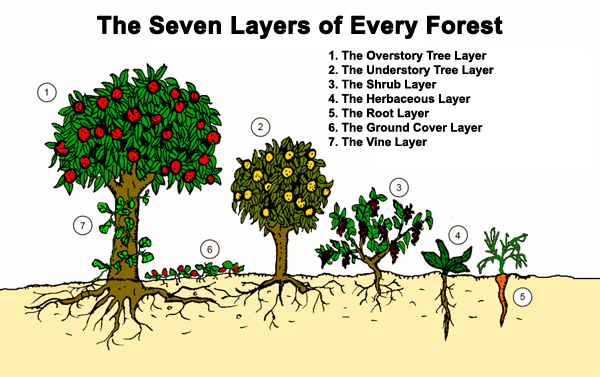
“Permaculture A Beginners Guide” – www.spiralseed.co.uk)
You can even support vines like passionfruit, grapes or hops on the overstory, and these all work together to offer a better overall harvest. these seven layers work together, performing a supporting function of each other to improve yield and efficiency
Mulch, Mulch, Mulch
Mulch is critically important in permaculture and serves several purposes. Protecting soil, supressing weeds, diversifying ecology, protecting roots and preventing water evaporation are just some of its major benefits. Furthermore, mulches can be made by recycling waste products in the garden, improving efficiency and reiforcing nutrient cycles that are otherwise interupted by exporting ‘waste’ out of your garden and into landfil.

Whether it’s living or decaying, it improves so much of what is happening. It adds nutrients. It protects the soil from drying out. It prevents the rain from eroding the soil are pounding it into concrete. It provides habitat for microorganisms, insects and all sorts of other things that are living in and constantly improving the soil
Johnathon Engel from PermacultureNews
Mulches can be as simple as prunings, straw, lawn clippings, chipped wood or bark. Spread around the garden and plants, it works its magic.
Check out our dedicated review on the best mulch to work out what types might work best in your garden.
Climate change and permaculture design
With climates changing and global agriculture becoming increasingly strained, permaculture design principles are becoming increasingly relevent to both hobby gardeners and professional farmers worldwide.
“Climate change compounds existing stressors on ecosystems. It adds complexity and presents new challenges for integrated assessment, planning, and management of natural resources“
Alexandra Jason, Australia’s landscapes in a changing climate
Conclusion
Following a permaculture design for growing your garden will change your perspective towards nature. You will learn to respect and preserve natural processes. As well as, it will teach you to live a healthy and sustainable life. Besides that, it will help to protect the biodiversity and health of the soil.
Using permaculture garden design at the market level will also help to reduce the creation of barren land. Therefore, the quality of food will improve with a reduction in the utilization of chemical fertilizers and pesticides. Thus, it shows permaculture is beneficial for our planet.
References and further reading
Alexandra Jason (2012) Australia’s landscapes in a changing climate—caution, hope, inspiration, and transformation. Crop and Pasture Science 63, 215-231. Available on the CSIRO website.