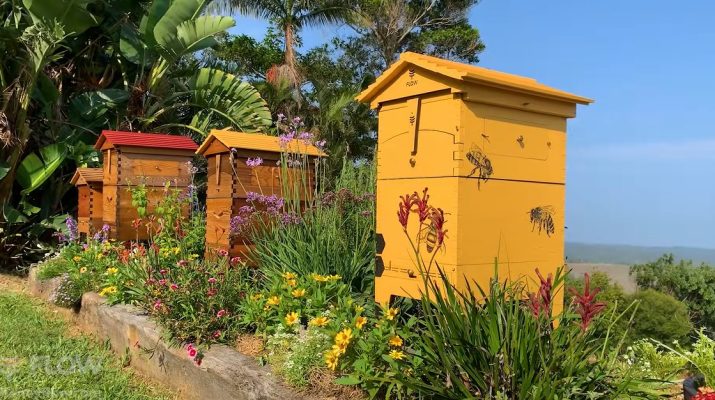
This article provides a comprehensive Flow hive review and comparison to traditional beekeeping techniques. Readers will learn about the advantages of the flow hive approach, its technology, and how it compares to other hives and beekeeping setups.
Introduction
Some of you may have come across small wooden box-shaped huts in backyards for beekeeping. These smart structures are designed for honey bees and to handle beekeeping in an advanced and smooth manner.
They are designed for ease of harvesting, without bothering or interrupting the honey bees. Let’s take a closer look at how they work and the pros and cons of these Australian-designed hives.
What is a Flow Hive?
A Flow hive is an innovative beekeeping invention created by father and son Cedar Anderson and Stuart Anderson in Australia. This frame-like design for the extraction of honey soon became popular in just 5-6 years due to its ease, comfort, and many other unique features described in our review. Surprisingly more than 6.5 million apiarists adopted this newly designed honey-keeping invention with positive feedback.
Flow’s recognition as a “Certified B Corporation” means their philosophy satisfies the “highest standards of environmental and social commitments” towards “Millennium Development Goals”.
The Flow hive, as the name suggests, is a structure in which honey is extracted in a flow without irritating the hive. The honey-extracting design modifies the sticky manual extraction of honeycombs. Instead, it has smartly designed frames with partially formed hexagonal vertical columns called “honey cells,” which are used as tiny honey containers.
“Cedar and Stuart are at the helm of a company that has matured into not only a successful Australian exporter, but a prominent advocate for bees and the natural world. A global community of hundreds of thousands of people has sprung up around the idea of being kinder to bees and taking better care of our local environment.”
honeyflow.com.au/pages/about-us
You simply turn the tap on the flow hive to start the honey flow, and voila! The honey will already be draining into your waiting jars. This process is much quicker, easier, and less labor-intensive than traditional beekeeping methods.
The individual combs are not teased during the process, so the bees don’t have to rebuild them. This significantly reduces stress for the bees and helps them stay healthier in the long run.
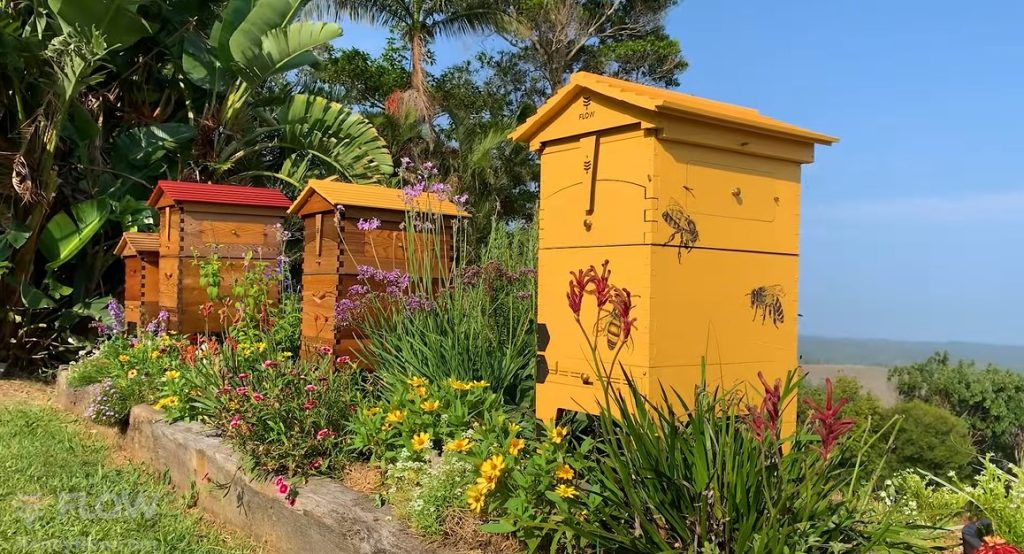
However, the yield values vary due to the external environment; honeybees count, and the health of bees. Nonetheless, one can expect to harvest up to 20kg of honey per box from a single Flow Hive.
The harvest time can also vary depending on how much hive activity there has been in the hive and when the last harvest occurred. It is also affected by hive temperature and sudden weather changes. That is why the Spring season is loved by most beekeepers!
How does a Flow Hive Work?
Flow Hives are composed of two main components: the frame and the box. The frame consists of cells pre-formed with hexagonal chambers partially filled with fresh honey. The frames fit into a special box connected to a honey-on-tap mechanism.
When the tap is turned, it releases little pressure on the honey cells so that natural space can take over, and the honey flows into jars placed beneath it.
The internal structure of the flow hive has inspired some of the experiments, yielding different varieties of honey from the same hive. Different nectar sources can be harvested from different hive areas, allowing you to experience unique flavors without disturbing other honeycomb cells.
You can even monitor the health of your bee without opening the hive. The flow hive has a built-in observation glass window so you can check on the bees and make sure they are healthy and happy.
How long do Flow hives last?
This depends on how you keep it and take care of it, and partially depends on the material it is made from.

As far as the material is concerned, Flow hives are made from durable, food-grade quality BPA/ BPS-free plastic frames. This makes them long-lasting, and one can expect a flow hive to last for at least three years with proper care. You should clean your flow hive regularly and store it in dry conditions when not in use.
The manufacturer also provides a 1-year warranty on all flow hives, so you can quickly get a replacement if you experience any technical difficulties during this time frame.
How much honey do you get from a Flow Hive per year?
The amount of honey produced with a flow hive depends on the number and size of frames you have installed. Generally, each flow frame has a 3kg capacity, so the more flow frames you install, the better your honey yield can be. It’s important to note that different colonies behave differently and may produce different amounts of honey in different seasons and climate changes.
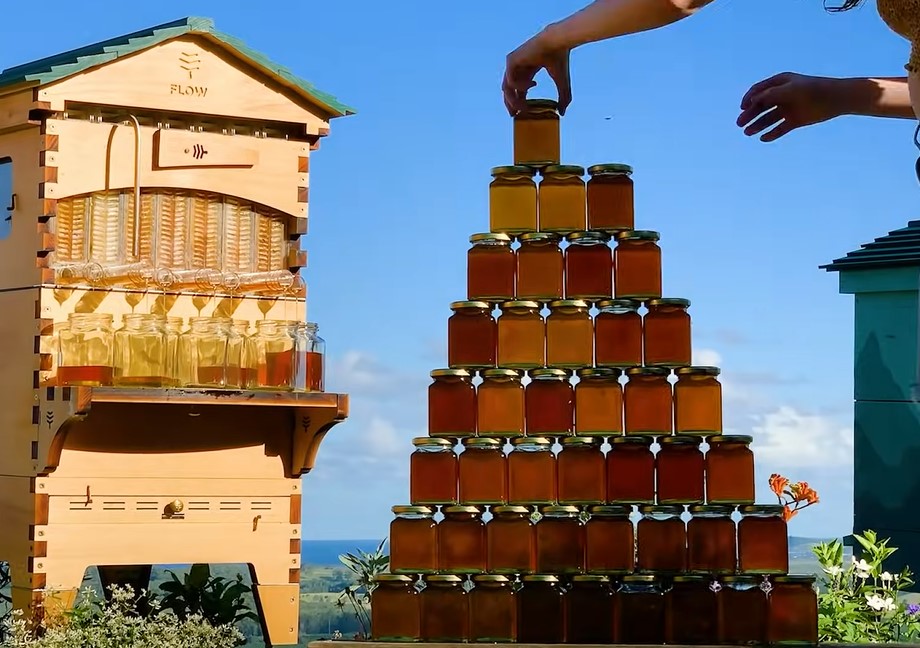
For example, if you have a 10-frame flow hive, you can expect to harvest around 30kg of honey in a supportive season of the hives. This is quite a bit more than the average traditional hive. Other factors affecting the amount of honey include weather, local nectar flow, and surrounding temperature.
Are Flow Hives good for beginners?
The Flow hive approach is great for beginners because it makes harvesting honey easier than traditional methods. No need to open the hive or disturb the bees with smoke, as the honey can be collected with minimal disturbance.
The flow hive is easy to assemble and requires less maintenance than a traditional hive. However, it’s important to note that beekeeping still requires some knowledge and understanding of the process, so beginners should still take time to learn about beekeeping practices before getting started.
How much does a Flow Hive cost?
Flow hives come in different sizes and designs and therefore, the pricing also varies. The flow hive classic is an affordable option at $649AUD. There is also Flow hive Hybrid. You can buy this model at $519. Flow hive 2 and flow hive 2+ are slightly more expensive. Their prices are $739 and $869, respectively.

Flow hives offer great value for money as they demand less effort than traditional hives and allow for a much easier harvest. You can also expect a higher yield of harvested honey with a flow hive super than a traditional hive.
Do commercial beekeepers use Flow Hives?
Flow hives are becoming increasingly popular with commercial beekeepers due to their ease of harvesting and excellent honey yields. As mentioned above, they can help you reach up to three times as much honey as a traditional hive. This makes them an attractive option for beekeepers looking to increase their harvest.
However, to some beekeepers, it may sound like Flow hives add nothing but an additional price. This opinion may show less understanding and weak comparative knowledge of Flow hive philosophy and design.

Can you put native bees in a Flow Hive?
No, Flow Hives are designed for honeybees and are not compatible with other species. Stingless native bees produce small amounts of honey and it is appropriate to keep them in traditional bee hives. It allows them to form the intricate structures they need to live.
Unfortunately, there has been a gap in hive research related to the experience of native bees in flow hives. As such, Flow hives are not suitable for native bees and should only be used with honeybees. You should also check your local regulations before keeping any bees, as some areas may restrict your use of hives.
Where can you buy a Flow Hive?
Flow hives can be purchased from the Flow hive company’s website, and you may be able to find some on Amazon. From classic Flow hives to the latest Flow hive 2+, you can find different models and sizes to suit your needs. You can also buy accessories such as beekeeping gloves, suits, frames, and more.
Advantages of using a Flow Hive:
Some of the advantages of using a Flow hive include the following:
Easier harvesting: You can collect honey without opening the entire hive or irritating the bees, which is much easier than traditional methods.
Higher yields: Flow hives typically produce three times more honey than traditional hives. This makes them an attractive option for those planning it for commercial purposes.
Less maintenance: Flow hives require less maintenance than traditional hives so it saves time and effort in the long run.
Easy to assemble: Flow hives are easy to assemble, allowing you to get started quickly and with minimal fuss.
Weatherproof: Flow hives are designed to be weatherproof, meaning they can withstand extreme temperatures and rain.
“Don’t worry about the bees getting squashed. We’ve designed it so no bees get harmed when the mechanism is activated, with little gaps they can safely hang out in while the honey flows out.”
honeyflow.com.au/pages/how-flow-works
Disadvantages of using a Flow Hive:
While Flow hives offer many advantages, there are also some disadvantages that you should consider:
Expensive: Flow hives are comparably more expensive than traditional hives, which can be a barrier for some beekeepers.
Not suitable for native bees: As mentioned above, Flow hives are not suitable for stingless native bees, as they require more intricate structures to survive.
FAQs about Flow Hives
Q: How long does it take for bees to fill a Flow hive?
A: It requires 1-3 weeks to fill a Flow hive, depending on the size of the colony. However, this depends on the local climate, temperature, and caretaking habits too.
Q: Do you leave Flow hives on over winter?
A: You can leave Flow hives on during winter. However, it must not be unsupervised for their health, and the colony needs to be well-fed throughout the winter.
Q: Is the Flow hive good for the bees?
A: Yes! Flow hives are designed with bee welfare in mind. The honey harvesting process is much easier and less disruptive than traditional methods, as they do not require opening the hive or disturbing the bees.
Q: Is the Flow hive worth it?
A: This will depend on your individual needs and circumstances. For some beekeepers, the ease of use and higher yields may make it worth the investment. However, others may prefer traditional Langstroth hives for their durability and flexibility. Ultimately, it is up to you to decide which hive will work best for your beekeeping needs.
Conclusion
With its smooth semi-auto flow into a jar, better yields, and improved bee welfare, Flow hives may be an attractive option for many beekeepers.
However, it is essential to remember that traditional hives may still be better in some circumstances due to their durability and flexibility.
Have you heard of or used Flow hives before? What are your thoughts on these types of hives?
Reference List:
1. https://gardenvarietybees.com/flow-hive-pros-and-cons/
2. https://www.ecopeanut.com/flow-hive-review/
3. https://beekeepinglikeagirl.com/is-the-flowhive-bad-for-bees/
4. https://backyardbeekeeping.iamcountryside.com/hives-equipment/my-flow-hive-three-years-in/
5. https://completebeehives.com/flow-beehive-reviews/
7. https://support.honeyflow.com/
8. https://www.youtube.com/watch?v=WbMV9qYIXqM
9. http://completebeehives.com/
10. https://en.wikipedia.org/wiki/Flow_Hive
11. https://beeprofessor.com/flow-hive-vs-langstroth-hive/
12. https://oraravalleyhoney.com.au/bees-wont-fill-flow-frames/
13. https://www.sciencefriday.com/educational-resources/why-do-bees-build-hexagonal-honeycomb-cells/
14. https://www.sciencedirect.com/science/article/pii/S1877050918304654